The Transom Hitchhiker

Snowmass to Aspen – 1977

In the 1970’s the building boom in Snowmass was in full swing.  In the summer of 1977 my father was doing the earth moving and backfill
work on a number of new homes up on Ridge Run Road.  One of the houses was being built by the daughter of Walt Disney and her husband, Ron Miller.  Over the weekend my father inadvertently left his surveyor transom on the job site.  When he found out I was going to a High School Party in Snowmass he asked if I would mind bringing it home with me that night.

By the 1970’s a lot of the kids attending high school actually lived up in the Snowmass Valley and commuted into town.  It was not uncommon for one of them to hold a party or two throughout the summer months and on this night a call went out to all of the “upperclassmen” to be sure to attend.  I did not have a car that night but Mark Menscher, a fellow classmate and friend offered to drive.

On our way to the party we stopped by and picked up the Transom.  It was very rare and extremely accurate.  It was kept in a custom made case, made of wood and padded throughout the inside.  All-in it must have weighed 60 pounds, coupled by the fact that all of the dials were made of in-laid sterling silver.  This thing was a beast to say the least.

Around 11:00pm I went looking for my ride and all I found was the transom where the car had been parked.  It turns out that Mark had left
hours earlier, thanks for the warning!  I headed down Ridge Run Road with my thumb firmly extended, hoping for a ride.  About a mile later I was offered a ride if I was willing to jump in the back of a mini-truck for a ride as far as Cemetery Lane, about a ½ mile short of my destination.  Did I mention it was about 40 degrees out and I did not have a coat?  That was a cold ride to town.

My journey home took about two hours including the rest stops I had to make every couple of yards on the “walking” portions of the trip.  The transom made it home safe and as I came in the house my mother heard me and asked how my evening was.  After a detailed description of my harrowing journey home all she had to say was, “You could have called, I would have come get you.”  Thanks mom!

Sadly a few years later the transom was stolen from a job site never to be seen again.  I thought for sure I would own that thing one day, after all; we “bonded” that late summer evening.
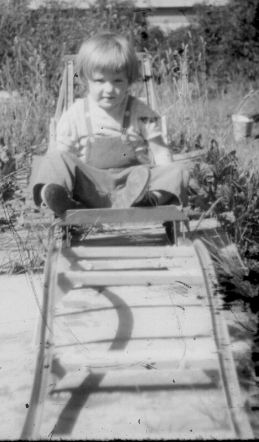
The Coaster of Doom

Cindy Beck, Age 5 ½ (Pictured)

Circa Early 1960’s

In today’s world this particular outdoor equipment could never exist but in the 1960’s that was a different story all together.  It was approximately 12 feet long and rose to a staggering 3 feet at its highest point.  There were no seatbelts and no safety systems to protect the riders but it was the most exciting 1.2 seconds a kid could have or adults for that matter.

As roller coasters go this was no “twister” but it was fun and it attracted all kinds of attention.  The rider sat on a flat “sled” with very small wheels and nothing to hold on to.  The ride started at the top, three feet off the ground and dropped slightly before rising up and over the first
hump.  Down a bit further to the second and last hump before screeching to a stop a mere twelve feet from the start.  If you were not paying attention you would arrive at the end, cart stopping in its tracks while the rider proceeded on until gravity did what it required and friction finished the job.

Kids would wait in line for their turn, bickering on whose turn it really was, for what seemed like hours.  The “coasting” was usually only interrupted buy an occasional accident with blood involved or by the proverbial, “bedtime.”  On some evenings when my parents had guests
over for dinner or drinks, the kids would soon find themselves relegated to other activities as the adults took on the “Coaster of Doom.”

I am not sure who actually got the roller coaster but I think it was actually a birthday gift for my brother.  But all of the kids and their friends had hours of fun.  Sure there were scrapes and bruises but none of us ever had to go to the hospital due to a derailment or other catastrophes.  One thing I am sure of is the fact that in today’s world a toy like this would come with all kinds of warnings and lawyer on retainer.

Deaf Camp Picnics – Mercedes 300SEL Off-Road Sedan

1960’s and 1970’s

The 1975 Deaf Camp Picnic was held in the parking area and adjoining field at the bottom of the “Camp Ground” chair lift in the Snowmass Valley.  The picnic had become so successful and attracted so many people this was the only location big enough to hold it.

By this time John Denver had not only committed his own band to perform but also convinced the members of The Nitty Gritty Dirt Band, Jimmy Buffett and The Eagles to donate some of their talents to the music acts.  The bands played for hours and did so rain or shine.  The valley also made the music echo throughout and it gave the music a special sound all of its own.

All of the picnics had no shortage of beer at a very low-cost.  Add to the fact that some of the attendees also enjoyed a bit of “whackie tobackie” throughout the day gave the picnics a very festive feel.  The downside was the fact that the location was 14 miles from Aspen over a dirt road to Snowmass Village or back up valley to the “divide” and over to highway 82.  There was no shortcut to getting home for any of the attendees, although some brought camping gear and slept off their “fun” returning safely home the next day.

At the 1975 picnic I was nine months away from getting my driver’s license and none of my fellow siblings were ready to leave when I wanted to.  Complaining a bit loudly, Steve Weisberg, John Denver’s lead guitarist offered me a ride home and I jumped at the chance.  Steve had been playing in John’s band for a few years.  At the time Steve was married to the daughter of the man who invented Fritos.  The two of them lived up by the Aspen High School in a nearby Highland’s sub-division.

I had met Steve on a number of occasions as John and sometimes his band played in my School every year from when I was in second or third grade until my junior year.  He did it as a favor of my Mom, Pam Beck as well as for another “serial volunteer” in the valley by the name of Trudy Barr.

Steve said his goodbyes to some of the nearby fans and we headed off to his car.  A Mercedes 300SEL with a 4.5 liter engine, it was beautiful!  I was, and remain to this day; a huge fan of Mercedes automobiles and this was by far the nicest one I had ever seen or had the pleasure to ride in.  As we exited the parking lot he had two choices, go left and take the rough dirt road, Divide Way; over the ridge and into Snowmass Village or go right and take the paved roads back to town over the “Watson Divide” and up highway 82.  I was certain Steve would go right as who in their right mind would drive this car on a jeep road?  Wrong! We went left.

I am not saying Steve did not appreciate the finer automobiles of the day but it is safe to say he did not worry about what happened to this one.  He drove fast and flew over the bumps and ruts in the road.  This car had nice suspension but even it could not compensate for the bigger rocks.  He slowed down only once and that was to say “Hi” to a friend headed the other direction, in a Jeep!

We hit the pavement still in once piece and the ride back to town from there was as smooth as glass.  Now I doubt Steve could even recall this particular event but for me, I had a blast and that car was nice!  It only took me 36 years to get one of my own, but it will never go off road.

Thanks for the lift Steve!

“The Deaf Camp benefit, every year, was the most stunning playing experience of my career. It eclipsed Red Rocks, Madison Square Garden and the likes. When the kids would put their hands on the stage to ‘hear’ our music, it was the most memorable audience reaction I’ve experienced to date.” – Steve Weisberg

The Carbondale to Aspen Express

Circa Early 1960’s or Maybe Late 50’s

The “old man” had long been homeless and enjoyed an occasional alcoholic beverage, or maybe more than one.  It is not to say he was an alcoholic, in fact little was known about the man even though he had lived in the valley for years.

What was known was that his past included time working for the railroad so the process of operating a diesel locomotive was not foreign to him.  The time it takes to get a locomotive ready for the rails from a cold start can often take hours so it was not uncommon to leave a locomotive idling in the rail yard for hours if not days.  On this particular day the yard crew had parked the locomotive on a siding while they headed into Carbondale for a meal.  When they returned from their meal, the locomotive was nowhere in sight.

The “Old Man” headed up valley towards Aspen from the Carbondale yard.  What the workers did know was what direction the locomotive had headed but the speed or intention of the hijacker was unknown.  With no other option, they quickly alerted the authorities.  The Roaring Fork Valley was and is still known to this day as a “rumor mill” or epic proportions and I am sure that the rumors of death and doom headed up valley faster than the “old man” and his ride.

The end of the line was just past the Rio Grande Yard in Aspen.  In earlier years the tracks completely circled town but as the mines shut down and the scrap iron was needed for the war efforts of World War One and Two the tracks were eventually taken up and the end was now by the old trestle along the river down by the Riverside Trailer Park, just below where the Aspen Eagles Club is located.  The Riverside Trailer Park was owned by Buck Buchannan who also happened to be the County’s surveyor at the time.

As some of the local authorities started looking for the missing locomotive others started blocking off intersections and evacuating the trailer park.  Convinced that the locomotive was headed straight for Aspen, they focused all of their efforts up valley.

Meanwhile back “down valley” the old man brought the locomotive slowly to a stop near the Woody Creek Store.  Without anyone noticing he”
tied down” or secured the locomotive walked a short distance to a nearby road and caught a ride the rest of the way into town.

It took some time for the authorities to work their way down the valley before locating the idling locomotive in Woody Creek.  The Hijacker
was long gone and probably finishing his second or third beer by then.  As days, perhaps weeks passed, some of the locals figured out who had committed the hijacking but no one was talking, especially the “old man.”


Pirouettes In The Snowmass

Winter of 1978

The original paved road to Snowmass from Highway 82 was a narrow two lane road.  Along most of the route up to the golf course there were fairly substantial ditches or drop-offs on both sides.  As you came out of the valley heading to the village the road curved and followed the side of the valley with the golf course to the south and the Snowmass Stables to the north.  Along this part of the road there were twelve foot ditches on both sides.

When the road was dry navigation up or down the valley was a simple affair but things changed dramatically in the winter especially after a snow storm.  The county did a great job of maintaining the road year round but even the best of plowing, scraping and a light dusting of
sand did little to reduce the slippery effects of the snow and ice.

A good friend of mine, John Braselton, and I spent the evening in town hanging with some other friends and by the time we realized it, the RFTA busses had stopped running to Snowmass for the evening.  With no alternative available, I agreed to give John a ride home despite the slick roads and freezing temperatures.  At the time I owned a 1957 Jeep CJ-3 with marginal tires and a very poor heating system.  Winter travel in this Jeep was always an adventure.

The trip up the valley was uneventful until we passed the Snowmass Stables.  Without warning, and no, it was not my fault; the Jeep began to spin 360s down the narrow road.  Luckily, no one was coming the other way.  After about three full rotations (pirouettes) the Jeep left the roadway and proceeded into the ditch.  Both of us were holding on for dear life and praying out load that the jeep would stay on its tires and not roll over.

We came to a stop at the bottom of the ditch in about two feet of snow which had plenty of mud buried underneath.  We both looked at each other with looks of amazement and a bit of lingering fear.  “What now” proclaimed John?  With any luck we could drive out of our predicament with the Stable’s road a few yards ahead of us.  It would give us a fighting chance.

That particular Jeep required a little extra effort to put it in four-wheel drive.  Now days you just shift the transmission into low but on the vehicles back then you had to climb out and lock the front wheels into four-wheel drive.  Each wheel had a knob on the hub that you had to turn to accomplish the task.  Unfortunately, it usually required the Jeep to move a few inches before locking the first wheel and additional moves before getting them both locked.  In this particular instance the Jeep would not budge and the rear wheel just spun in the mud.  After a few tries I was successful at getting them locked.  Without hesitation the Jeep began to move and in a matter of minutes we were back on the roadway.

The remaining journey up to John’s house was done in silence.  The trip home took twice as long as I approached every inch of the road as if it
were a sheet of ice coated in oil.  As I passed by the part where we performed our pirouettes I could clearly see the tracks in the road where we performed three complete, and perfect I might add, rotations and where we left the road.  Had it happened 10 feet sooner we would have been in a whole about 20 feet deep with a significantly different outcome.

The next day after our nerves had calmed back down we began to tell others of our misadventure and “near death” experience.

The Runaway Jeep Commando

Summer 1973

In the 1970’s my father had a Jeep Commando, or depending on its actual year it might have been a Jeepster Commando made by Kaiser Motors.  Either way it was a workhorse.  In the winter it was fitted with a plow and a hydraulic system and was used for every storm to
plow local driveways and back alleys.  I personally drove it into more snow banks and deep ditches than I could count.  Opal Marolt had that Commando to thank for winter passage out of her long driveway out at what is now called the “Holden-Marolt” property.

During the summer it was relegated to errands and an occasional “jeep” trip into the hills around town.  My father was always very generous
with his vehicles and let any of the family members use them as long as they put gas in them when they were finished, a challenge for some of his kids.

In the summer of 1973, long before I was licensed to drive, my sister Cindy took a number of her friends for a jeep trip up Aspen Mountain in the Commando.  This trip happened to be the day before the annual Deaf Camp Picnic and my parents were busy with the final preparations of
the picnic.

The trip up was uneventful and the four of them enjoyed a nice day in the “high country.”  On the way down things took a turn for the
worst.  Heading down the road just under Lift One the Commando began to sputter and the engine dies.  Now this particular Commando had an automatic transmission and power “everything.”

Cindy immediately panicked when she went to stop the vehicle and nothing happened.  It became sluggish to steer and Cindy stared death straight in the eye.  With no alternative she jumped out of the slow moving vehicle, leaving her companions to fend for themselves.  As she exited the vehicle she fell hard against the road and adjoining hillside and was pretty scrapped up.  The gentleman sitting next to her responded by reaching over and steering the Commando into the hillside bringing it safely to a stop.

Cindy rejoined the group, a bit scrapped up, and was able to get the Commando started again for the return trip home.  Although it was very low on gas it did have enough to get them home but just barely.  Driving the rough road partially starved the vehicle of gas just long enough to kill the engine.  Without the assistance of the engine the powered brakes and steering depending more on human strength and Cindy was unaware of that fact.

As to how she explained her way out of abandoning her friends on a steep jeep road, that part of the story I will never know.

Toklat Aspen – A Swinging Affair

Circa 1960’s

The Toklat Restaurant, long known for its location up at Ashcroft, south-east of Aspen up the Castle Creek Valley actually was once located in what later became the home of the first Chart House Restaurant.

Stewart Mace, proprietor and local naturalist was also a man of vision and creativity.  The Toklat Restaurant was no exception.  One very innovative, if not somewhat misguided, idea was to suspend the tables on bars from the ceiling.  The concept was quit ingénues on the surface.  If you had a table of four and a group of six patrons came in why not swap out the smaller table for a bigger one?

The tables were attached on all four corners and could easily be swapped out for a larger table top by simply detaching it and replacing it with a bigger one.  Aside from the obvious questions of it swinging wildly at the hands of a youthful guest it made for cutting your steak or chicken a family affair.  The upside was that there were no legs to jam your knees into and playing “footsie” with others at the table was an unobstructed game.  My sisters loved to kick me in the knee whenever I said something they did not agree with and they were deadly accurate without table legs getting in the way.

One evening while at dinner with my family tragedy struck.  I am not sure it was the first time an event of this type took place but it was most
likely the last.  That night and elderly man came in with his family.  Assisted by the use of a cane the gentlemen approached the table and reached out to it to improve his balance.  Without warning, as his hand pressed against the corner of the table it promptly swung out of the
way and the man fell to the ground.  To add insult to injury the table clocked him in the head on its back-swing and down for the count he went.  Faster than a bolt of lightning he was quickly surrounded by family and employees alike.  He was actually good natured about the whole event, if not a bit embarrassed.

Our next dinner at the Toklat was a few months later and one notable difference was the chains attached to each table and tied to the floors.  Gone were the free swinging tables we all knew.  A few years later the Toklat moved to Ashcroft and The Chart House moved in from the old A-Frames over by The Little Nell where it originally started.  The Chart House Remained in that location until the mid-2000’s when it finally closed its doors.

Deaf Camp Picnics – Rubber Stamps and Saloons

1960’s and 1970’s

In the first two or three years of Deaf Camp Picnics everything was done on a “shoestring” budget.  The school needed every dime it could get to
buy land and build world class facilities, or facilities of some sort to begin with.  As time went the picnic got a meager budget but relied on its volunteer army of locals to get the job done.

My mom not only recruited every friend she had, she also recruited their kids, cousins and even in-laws.  There was work to be done and any willing hand was always appreciated.  One of the annual event’s biggest attractions was the raffle.  Local businesses of all sizes were asked to
pitch in with raffle items and the list quickly grew.  Everything from skis to season passes was up for winning.  By the 3rd year the Chevrolet Dealership in Glenwood even offered up a new Pick-up Truck (won by Francis Kalmes).  Raffle tickets went faster than we could make them, yes, make them.

My mom had a couple of rubber stamps made that were about two inches by four inches which included a description and year of the picnic.  She also purchased a couple of the stamps of the time that had adjustable dates.  Added to that she purchased a stamp that had roiling numbers that could go from zero to 9999.  With a bunch of red pieces of paper cut to the perfect size, thanks to the local office supply store we proceeded to make raffle tickets one at a time. As we ran low, we just made more with no limit to how many could be made.  Night after night we stamped, dated and numbered raffle tickets.  We could not keep them in stock thanks to the efforts of about a dozen local kids and a few adults willing to accost every person that even approached the local post office.  This was well before local home delivery had arrived in the valley.  If you got mail you had to go the local “PO” to get it.

Every evening after school the kids lined up at our house to get more tickets.  Then off to The Elk’s, The Eagles, The Pub, The “Onion” and even local restaurants the kids went, tickets in hand.  No saloon, Bar, restaurant or hotel lobby was safe from the marauding kids.  By nightfall each of us returned to my parent’s house with wads of dollar bills and stubs where whole tickets once existed.

My mother never shared with the kids how much they sold from a dollar value but it is a safe bet that it exceeded the five figure range.  We
had a blast doing it and the Deaf Camp benefited from pour efforts.  So many things happened in the valley as a result of the picnics and my mom loved the work.  For her the adventures and stories were worth the journey.


Deaf Camp Picnics – Coleslaw Wedding Ring

1960’s and 1970’s

In order to host the best picnic of the year it took a lot of volunteers and a little bit of luck.  The Deaf Camp Picnic of 1971 was no exception.  The task of preparing enough food for 1,000 plus guests, paying guests, fell on a small team of local cooks, laborers and housewives not to mention a number of Aspen’s restaurant kitchens.  By 1970 the picnics were in their third year and attendance had exceeded the 1,000 guest mark and rapidly heading to 2,000.

This year’s picnic was being held up at the Cattleman’s Association property up Castle Creek just past the end of the pavement.  To be more
specific, just past the old Four Season’s Resort (Aspen Country Day School Campus) about two miles from Aspen’s downtown.  This was the second year for the picnic to be hosted in this location.

To name all of the volunteers by name would be a task in itself especially for a then ten year old busy little boy.  I wish I could name them all as they deserve the recognition but alas, I am unable.  To name a few the ranks included my aunt and uncle, Shirley and Nelson “Jr” Smith as well as their numerous brothers and sisters.  There were Zordel’s, Clapper’s, Nicholson’s, Tacker’s, Guy’s, Smiths too numerous to name, Caparella’s,
Stapleton’s, Thorpe’s, and of course Beck’s and many more.  Temple Allen, then owner of the hickoryHouse, offered up his smoke oven for the 1,000’s of pounds of Barbeque Ribs as well as his kitchen for what amounted to two hundred pounds of his special coleslaw.  Bin after bin of cabbage, mayo and spices were trucked up to the picnic the morning of the big event.

Off in a corner of the field the “field Kitchen” was a bustling place while we all enjoyed the sweet sounds of Sandy Monroe and his band warming up as the opening and closing acts.  The sweet sound of his mandolin echoed through the valley.  Guests were only beginning to arrive and there was an excitement in the air.  My mom and her minion of volunteers were busy putting the final touches on everything from the raffle tickets sold and yet to be sold as well as making arrangements for the music, parking and places for everyone to sit.

Back in the kitchen a number of us were assigned the task of mixing up the bins of coleslaw.  More than 12 ten gallon bins were filled with
cabbage and there was mixing to do.  No able hands went un-used regardless of age.  On a day like today, child labor was not a bad thing.  My brother and sisters were all in the mix helping out where they could.  My sister Cindy was our moral support after an accident the day before while jeeping, she was a bit scarred up but her spirit was undiminished and we were glad to have her.

One of the adultvolunteers that took the lead on the “Great Coleslaw Mix” was a black local man by the name of Earl Wyatt who had a cleaning service in town.  He was very expressive and loved kids and kids loved him to, that was why we all flocked to help him in the coleslaw pits.  About an hour into the mixing he discovered his wedding ring was missing.  At first he thought he had taken it off only to be reminded by his
nearby wife that he never takes it off and was not about to today.  We quickly realized the ring was in one of the 12 plus bins of now “mixed” slaw.  The team of “slaw cooks” proceeded to dig through all of the bins, looking for a small gold band.  It is safe to say the air was filled with wisecracks of all kinds, “Maybe we should sell raffle tickets to east the slaw”, or “Does the guests who finds the ring get the owner as their husband?” assuming it would be a female guest.  After about 20 minutes of looking the ring was located, in his pocket.

This was only one of many great stories that came out of the annual Deaf Camp Picnics and my mom’s effort to host the best parties Aspen had ever seen.

Deaf Camp Picnics – Where it all Began

Aspen
Summer Camp for the Deaf, Inc. on October 6, 1967

In 1967 Reed Harris, a close family friend, came to my Mother to see if she would help him start a camp for children with hearing disabilities or total deafness.  Reed had a son who was deaf and he was very passionate about helping the deaf community.  The foundation was based out of Reed’s El Jebel home with most of the administrative tasks performed by my mom from our home office.  They immediately set out to establish the foundation with the necessary funds to make it successful.

In the early years Summer Picnics were established to raise the money to operate the camp.  Local businesses donated items for raffles and the tickets were sold all over town, mainly by family members and friends.   In the second year of Picnic a GMC Truck was the main raffle attraction which was donated by the local Glenwood Springs GMC dealership.

Each year the picnics doubled in size.  The first picnic was held in the back yard of one of the volunteers.  By the second year, the picnic already
needed a new home.  The Cattleman’s Association offered up their picnic area up Castle Creek where it remained for the next few years.

Over the years my father had done work for John Denver and he had become a family friend.  Wwaterhen my mom approached John to see if he and his band would volunteer to play at the picnic, he was more than enthusiastic and offered to invite other bands to play as well.  With John headlining, a larger place for the picnic was needed.  There was a large track of land at the base of the Campground Chair Lift in the Snowmass Valley made available.  This new location had a lot of room for the picnic as well as plenty of parking.  John secured a band stand which was large enough to accommodate plenty of musicians and their required equipment.

By John’s second year he started inviting members of The Nitty Gritty Dirt Band, Jimmy Buffett and some of the Eagles as well as other big names.  The crowds grew exponentially each year and the “Camp” was in good hands financially.  These picnics were my mom’s contribution to the camp and they eventually took their toll.  The work required her full time and she still had a family to take care of and a home based business that she and my father ran.  By the mid-1970 my mother had to step down and pass the picnic on to others to manage.

These picnics provided a lot of entertaining stories to tell but those will have to wait for now.  Reed and my mother are both gone from the camp and each has passed away.  They started something wonderful and their legacy lives on today.