It Couldn’t Go Very Fast But It Could Climb A Tree!

1943 Willys Jeep “Army Surplus”

1974 – 1977
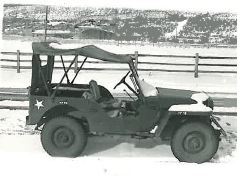
 As the four kids in our family all came of age to drive my parents did their best to provide decent transportation for us.  That was not to say we all got shiny new cars on our 16th birthday, but we did get a “shared” vehicle that provided round-trip transportation to and from school.  If we wanted something nicer it was up to us to get it ourselves.  Over the years shared an old Chevy Pickup, a 1943 Willys Jeep, an International Harvester Scout complete with a snowplow and hydraulic controls to name a few.  Of them all my favorite was the Jeep.  It was not very fast but it could climb a tree.

In the winter the Jeep did not provide much protection from the elements and its heater did nothing to bring comfort to its occupants.  On the cold, snowy days when we showered before school we would arrive to school with frozen locks of hair pointing in all directions, the girls looked more like Medusa than school girls.  As for me, I always wore a ball cap and when I removed in as I was required to do my hair looked as if it was still on.  The first class of the day always included wet paper as our hair slowly thawed.

Another unintended consequence of owning a used vehicle was that no all of its gauges or accessories worked.  For the Jeep the gas gauge was the most obvious.  None of us were real good about keeping the Jeep full of fuel and my oldest sister, Cindy was the worst.  I think she believed it filled itself and as long as the engine started it must have gas.  On more than one occasion we fell victim to running out of gas at the most inopportune times.  One morning on the day it was Cindy’s turn to drive we headed off to school.  About
half way across the Castle Creek Bridge the Jeep rolled to a stop, it was out of gas.  Without hesitation Cindy jumped out of the Jeep and proceeded to hitch-hike.  In what seemed like seconds a friend of hers drove by and picked her up as the other three of us sat there in the Jeep wondering what had just transpired.  This would turn out in later years to be something she was prone to do.

On that day, with snow falling and sub-zero temperatures, we pushed the Jeep to the far end of the bridge and walked a few blocks to my father’s “shop” where he kept his construction equipment and retrieved a couple gallons of gas.

Over the years we used the Jeep for school transportation as well as recreational four-wheeling.  I am not sure at what point it was sold off but my very first car was certainly an upgrade.  In 1977 I purchased a 1952 Jeep “Civilian Jeep” CJ-3B.  It was not very fast but it too could climb a tree.

Elk Horn at Where?

Winter 1970

The Learjet 25 came from out of know where, 100 feet above the sundeck and heading down the ridge over Ruthie’s and eventually turning sharp towards the northwest as Shadow Mountain dropped off below them to the valley floor.  The film crew applauded themselves for a job well done but the lead photographer wanted
to a “do over.”

A brief conversation over a two-way radio and the jet climbed vertically as it crossed over the mid-field of Sardy Field, Aspen’s local airport.  Still a bit surprised and excited about its first pass over the top of Aspen Mountain, just a mere 100 feet or less above us, I could now look forward for a second pass and this time I knew it was coming.

Painted a light brown on the bottom and the customary white on top, this Learjet was a beautiful sight.  The logo on the tail was un-familiar and the words down the side of the jet left more questions than answers, Elk Horn at Sun Valley.  What was this plane doing in Aspen and why was there a film crew in tow?

The Next day I was out visiting my friends in the tower out at the airport and much to my surprise the Jet was parked nearby.  Again the aircraft was surrounded by photographers as the plane started its engines and taxied out.  The film crew proceeded out to the taxi way and set up their cameras.  As the plane passed them during its take-off roll all the cameras were abuzz.  Once again, this was not the plane’s last appearance.  Moments later as radio transmission, played on the ramp’s loudspeakers, was a conversation between the tower and the Learjet’s pilots, they were requesting permission to make a high speed, low altitude pass over
the runway.

With all the other aircraft traffic cleared from the vicinity of the airport permission was granted for the pass.  By this time everyone on the ramp knew what was about to happen and we were all lined up along the edge of the ramp as close to the runway as possible.

The fly-by was over with a blink of an eye and before you knew it the jet was climbing out nearly vertical over Shale Bluff.  A second request was made by the pilots for another pass which was quickly granted as the plane came back around over Buttermilk Mountain and headed straight in for runway 15.  This time we were in for an even bigger treat.  As the plane approached the end of the runway the landing gear was retracted and the jet dropped to about 50 feet off the ground.  It sped up as it approached mid-field and began a vertical climb just as it passed the film crew and spectators.  It climbed so steep and so fast that you could see the top of the jet as it went skyward.

Within minutes the film crew packed up and left and the jet was never seen again.  I later learned that a new resort just outside of Sun Valley, Idaho was about to open and the developers needed some good photos of the area for the clientele they were hoping to attract there.  Since the resort was not yet complete, Aspen was used as a “stand in” for the marketing department.  As a ten year old aviation enthusiast who spent considerable time hanging out at the airport, this was a pretty exciting weekend and memorable to say the least.

Aspen had Dirt Roads?

Until the 1960’s & 70’s

As an adult I love to tell my “city slicker” friends how I grew up on a dirt street.  They struggle with that concept knowing that I grew up in Aspen.  Almost everyone who has ever heard of Aspen think its streets are paved with gold or at least a thick layer of asphalt.  They cannot fathom that Aspen ever had dirt streets.
Not only did it have dirt streets but the fact of the matter is that was not that long ago.

For my first eleven years we lived at the intersection of Garmisch and Hopkins.  Back then many of the “side streets” were dirt and they were quite a bit wider than they are now.  Every year the city would pick a few of the streets to either pave or just spray oil and spread small gravel which gave it a semi-paved look and feel.  Still you could drive down any of those streets and put up a pretty big dust cloud behind you.  When it rained it was hard telling where the streets ended and the yards started.  There was no storm drains either.  One summer Aspen experienced a 10 day rain and water collected everywhere.  One of the lowest spots in
my neighborhood was at Garmisch and just south of Main Street.  During and after that particular storm there was a puddle that was over 3 feet deep in the middle of the street and half of the park was flooded as well.  All of the kids had blast playing in the water until it finally drained away.

In the 1960’s the Castle Creek Road pavement ended just past the Country Day school campus which at that time had a very nice restaurant, tennis and swimming club.    Just past the Highlands the pavement on Maroon Creek Road ended which was later extended just past the T Lazy 7 Ranch.  The fact of the matter was, the Red Mountain Road was paved to the top long before most of the other area roads.

For kids, our primary form of transportation was bicycles and we went everywhere.  On any given weekend kids would ride to the Maroon Bells, up Red Mountain or out to the Difficult Campground choking on the dust clouds every step of the way.  As for Garmisch and Main, that intersection as well as many others like it throughout town have been upgraded with storm drains, re-contoured to eliminate low spots and paved from curb to curb.  Gone are the days of dirt roads and mud puddles.

Thunder & Lightning! See Grey Go!

1970’s

During my high school years I hung out with a number of good friends, most notably Mark Menscher and his younger brother Steve.  They lived down on Meadows Lane which was a short walk from my house.  We spent a good amount of time at each other’s homes after school, on weekends and during the summers.

During that time the Menschers had a number of pets including Grey, which was an Australian Sheepdog or a similar breed.  Grey was a fun dog and always loved to hang out with us.  She rarely left the confines of their yard, preferring to stay close to home.  That was with one exception.

Somewhere along in Grey’s early years she had somehow convinced herself that the only way to stay alive during a thunder storm was to run and keep running as long at the lightning continued to strike and the thunder continued to boom.  She would also spend the entire time on the run barking as if to scare the storm away. If she were locked in the house she would find a way out even if it meant breaking down a screen door or running through a pane of glass.  If you stood in her way she would bark and jump at you until you let her out.  Over time the Menschers learned it was easier to let her out than to fight her to stay in the house.

The close proximity to their house also meant our house was on her usual lightning route and we could count on a hasty visit through our neighborhood and the entire “West End” during every summer storm.  You could never catch her during her lightning evasion and as soon as the storm was over she would return to the safety of her yard as if nothing ever happened.

Grey was still on the run every summer up to the year I graduated high school in 1979 as I went off to college.  I am not sure how long she continued her lightning runs but by the grace of god it never struck her down.

The Grizzly Creek Mouse Trap

1970’s & 1980’s

As beautiful as the Aspen Valley and surrounding mountains are, they are also filled unforgiving wilderness, Weather and mountain valleys.  Aspen also had one of the busiest general aviation airports in the country.
Mountain flying requires an attention to detail not often thought of in the lowlands and planes of the United States.  Many pilots mistakenly believed that, if they can fly in overcrowded skies of any major metropolitan area, then the mountains should be a “walk in the park.”  This belief often resulted in disaster.

As a young teenager my love of all things aviation was well established.  Family friends like Richard Bird or General Martin (USAF Ret.) owned their own aircraft and they were always willing to let me tag along, even taking the controls when it was safe.  By age 16 I already had many hours of flying time and my love of aviation went unabated.

During this same time period aviation charts and technology was still mainly accomplished by large maps known as “sectionals” and human control.  For nearly two decades from the late 1960’s well into the early 1990’s, Aspen lost dozens of aircraft to pilot error and bad planning.  Some of these aircraft went unfound for months and even years in a few cases.  These aircraft accidents took famous as well as infamous people alike.  Among them, Dr. Lovelace of “The Lovelace Clinic” and early Apollo space missions fame, as well as the heir to the F.W. Woolworth fortune, a young playboy by the name of Lance Reventlow.  Many local aviators who
should have known better also fell victim to the treacherous flying conditions of the area.

One of the more common locations for downed aircraft was up Independence Pass near the Grizzly Reservoir.  As aircraft headed out of the valley, east towards Denver the logical route took them over Independence.  About half way up the valley floor split into two valleys.  One continued up Independence Pass and the other went further south towards the reservoir.  For aircraft heading out, their first mistake was to follow the valley to the south in error.  Not far up that valley a second valley branched off to the north which looked remarkably similar to what the Independence valley looked like.  For pilots choosing to follow that valley it was usually a fatal mistake.  The valley is known as Grizzly Creek and it is a “box canyon” with 13,000 plus feet walls on three sides.  Once in the canyon few aircraft had the power or ability to climb over the walls in such a short distance.  Many could not execute a turn quick enough to go back out of the valley from the direction they entered it.

Sadly, many aircraft were found on the valley floor, no survivors.

When an aircraft was reported as missing it was often the first place the rescuers looked if the aircraft headed out of the valley in that direction.  The Lenado Valley, north of the airport took a fair number of aircraft over the years as well, but go in any direction from Aspen’s airport and you will most likely pass over a former crash location. Grizzly Creek took most of its victims in the winter when the two valleys looked even more similar as the snow did a good job of hiding geological features that could help the pilots from making fatal decisions.   At that time “The General” Martin owned a Ted Smith Aerostar.  This was a mid-winged, twin-engine aircraft and he had equipped it with an Emergency Locator receiver.  Most aircraft are equipped with a device known as an “Emergency Locator Transmitter (ELT)” which goes off upon impact or manually in the event of an emergency.  At the same time, most aircraft monitor the frequency that they transmit on as well as all Federal Aviation Administration (FAA) facilities.  The General’s Aerostar went one step further and had a device that not only picked up the transmissions but also guided the aircraft and crew to the source of the
transmissions.  I often acted as his co-pilot and “spotter” for these rescue missions.

Another peril of Grizzly Creek was the avalanche danger in the winter.  In order to get into the valley from the
canyon entrance, the rescue teams utilized snow cats and snowmobiles or had the use of US Army helicopters.  The noise of this equipment could cause an avalanche and put more people in danger.  We often flew circles over the valley, well above the canyon walls as the teams went in to get the bodies.  If any sort of movement on the canyon walls was detected, we called out to the teams to leave the valley.

By the early 1990’s technologies such as GPS’s and digital maps largely eliminated the risks of mountain flying and taking the wrong routes.  Accidents due to Pilots taking the wrong routes in and around Aspen have become largely a thing of the past.

Shadow Mountain Hippies and Hoodlums

1960’s and 70’s

 During the mining days of Aspen, Shadow Mountain not only kept a watchful eye over the town below, it was also home to many mines, home stakes and even a few mysteries of its own.  One of Aspen’s two railroads passed by at the foot of Shadow Mountain while the other railroad traversed the valley on the Red Mountain Side.  Although called Shadow Mountain it was really the west side of Aspen Mountain and not a separate geological edifice.  I do not know when Shadow Mountain ends and Aspen Mountain begins but I suspect some of Aspen’s remaining “old timers” might know.

By the early 1960’s the mountain and many of its remaining cabins, mines and abandoned shafts had long been dormant or abandoned.  The mountain and all its hidden treasures became a playground for the local kids and “collectors” of Aspen’s past.  At one time many of the kids had collected valuable items like assay
cups (small ceramic bowls), glass transformers and even an occasional abandoned mine car, although most of the cars were already landscaping features throughout the valley.

In the mid-1960’s the “Hippie” scene was taking place all over the country and Aspen was no exception.  Soon the parks filled up with the “fun loving” beatniks, clothing optional.  The smell of roasted cannabis permeated every nook and cranny of the valley.  The local law enforcement turned a blind eye to most of the hippies but often, under public pressure, drove them from the parks so the local rugby games or family picnics had a place to be.  For some of the hippies the constant pressure to “fit in” was too much and they ended up
leaving the valley for greener pastures.  Others worked their way into society and remain to this day.  Even more of the Hippies headed to the hills around town.  Many of the abandoned miner’s cabins soon filled up with uninvited guests and Shadow Mountain soon had a bustling population of Hippies and squatters.

For the kids of the valley that meant we were no longer welcome and were constantly being chased off by the very people who retreated from a similar fate.  Over the years some of the cabins were slowly converted into mansions while others were torn down or burned down and eventually the area was no longer open to any of us.  At one time there was even an old railroad parlor car parked along the base of the mountain, it had been converted in to a restaurant with the unimaginative name of, “The Parlor Car.”  With property alues climbing at an astronomical rate, even the Parlor Car was soon replaced by a large home.

Many of the old mines and caves have been obliterated by now, replaced by homes and driveways, but for the kids of that era we still remember the place as a playground filled with adventures and buried treasures.

Pine Boards, Laces and Leather Thongs

Until the early 1970’s

If you ever went anywhere near a ski area, they did not call them resorts back then, from
the beginning of the sport until the early 1970’s you knew the best skis available were made of wood.  Ski poles started out as bamboo or a good straight twig from your back yard with some sort of basket or stopper on one end.

By the 1960’s a number of companies in the United States and Europe we making names of
themselves as ski equipment manufacturers.  Disappearing were the twelve foot long wooden skis, bamboo poles and U.S. Army surplus winter wear originally issued to the men of the 10th Mountain Division.  Dynastar, Fisher, Head, Solomon, Heart and Bogner skis were taking to the slopes to name just a few.  I for one had my Fisher “Reds” and boy were they fast!

A little slower to the show were the binding and boots.  Ski Boots back then had an inner boot which you had to lace up and tie as tightly as possibly only to be surrounded by an outer boot that also required a certain amount of dexterity to properly tie, that was what moms were good for.  Once the dexterity test was
passed the next challenge was to get your boots attached to your skis.

Bindings were comprised of long cables, metal guides along the skis and finger pinching latches in front of your boot.  You had to lean so far forward to latch the binding that you often fell out of the ski before the task was completed.  To ensure safety the skis also had long leather thongs that were wrapped about 4 times
around the boot and then cinched onto the bindings.  At 8,000 feet you were exhausted before you took your first ride up the ski lift.

Having snow on your skis was just not permitted and the easiest was to get it off was to bang your skis together while riding of the lift.  This often resulted in the bindings coming undone and your ski plummeted to the earth.  If you were lucky enough the leather thong keep the ski with you, albeit hanging about 4 feet below you.  As you approached to top of the lift humiliation set in as the lift was brought to a slow crawl while everyone watch the operator assist you and your malfunction gear to safety.  At that point you wished the thong had failed and the ski was somewhere back behind you.

The other advantage to cable bindings and thong safety straps was in the case of a crash.  In almost every occurrence the bindings would release and “safety Straps” would keep the skis attached only to have them fly about like a kite out of control at the end of its rope eventually hitting the skier somewhere on their torso of face.  In the event that the strap failed to keep the ski with the skier during the melee you always count on the ski to head down the hill, skier-less only to take out some other unsuspecting skier below you.  It is amazing how fast a ski could go with no one attached.

Now days the boots are plastic, skies are made of all kinds of synthetic materials and the safety straps have been replaced by breaks.  Skiing is just not the same any more.

Buck and the RWI

Early 1960’s

Every town has its fair share of “over-the-top” local constables and Aspen is no
different.  That is not to say that some of Aspen’s past law enforcement officials did not do a good job but it is fair to say that some of them performed their duties with a bit more panache’ or maybe too much bravado.  And some were downright mean.

One of the more colorful law enforcement officials was a man by the name of Buck Davis,
local Undersheriff of Pitkin County.  To say he was officious would be putting it lightly.

My father enjoyed a beverage or two after a hard day’s work and he often found it easier
to ride his bike to and from the bars rather than deal with the parking issues of the day.  He lived with his family next to Peapcke Park so his rides into town were really no more than four or five blocks depending on which bar he chose to go to.  My dad actually rode his bike all over the valley, usually preferring it over driving, as did the rest of his family.

On this particular night my father had a number of “beverages” prior to heading
home.  He could not have gone more than a block or two when Buck had him in his sights.
“Riding While Intoxicated” was the crime and dad was caught red handed.  A conversation ensued, one Buck
would not lose, and soon my father was on foot with Buck following behind, in his squad car.  Either my father walked his bike home or off to jail, it was up to him. Electing the short walk home, Buck made sure that my father did not attempt to remount his rubber wheeled steed and ride home.

It was always good to know Aspen’s streets were safe from “RWI” offenders.  This was classic Buck and a little research on your own would prove he was no “push over” by those local hoodlums who roamed the streets on foot or a steed.

Thanks Buck!