Fluoride, Red Pills & a Little “Yack”!

“National Brush in Day”

 I am not sure what the person was thinking that came up with “Brush In Day” but clearly social services should have been involved at some point.  This form of child abuse has long ended but back in the 1960’s and 70’s it seemed to a sanctioned event by our parents, or maybe they just were not paying attention.

There has been some debate where it took place.  Some say it was in the front lawn of the Red Brick School, Aspen Middle School at the time.  Others say it took place in the playground of the Yellow Brick School, the Aspen Elementary School at the time.  I believe both camps may be right based on which year the crime took place.  I for one remember most vividly, having all of us paraded from the school to Peapcke Park one block away.  At the time, before we picked up our house and moved it, we lived across the street from the park.

The crime went like this… all of the students were lined up in the park, or whatever venue it took place that year.  Each student was given a small “dab” of fluoride paste, a Dixie cup of water and a small red chewable pill.  We also got a small, toothbrush to aid in committing this travesty.  Very exacting instructions were given to us, dip the toothbrush in the water and then rub it the pile of fluoride.  At that point the punishment commenced when we were told to thoroughly brush our teeth.  Once the gagging and brushing stopped, we were allowed to spit out the paste.  Many followed that act with a retching sound; some even fertilized the grass at that point.  I was glad that I was yet to eat my lunch.  My mom’s standard affair of white bread lathered in Miracle Whip and processed American cheese.  Had I already had lunch, that sandwich would have come up faster than greased lightning.  But I digress.

For those of us not busy “selling Buicks” our next task was to chew up that little red pill.  After what we had already been forced to put in our mouths, the pill was a non-event.  What it revealed was another story.  That damn pill showed the teachers and dentists in attendance just how poorly we had brushed our teeth on the first go-around.

Rinse and repeat!  More nasty fluoride and brushing ensued.  More throwing up, gagging and even more groaning became the order of the day.

When the carnage was over the park was a white as snow, even some yellow snow if you catch my drift.  Let’s not forget, this was in the 1960’s and there was another side effect to this whole ordeal.  Peapcke Park was a “safe haven” for the hippies and druggies of the day.  After watching a bunch of brushing, gagging and yacking children, many of the hippies disappeared into the hills and did not come back for over a week.

My memory is strong but even it has some gaps but as for this annual event, I recall about four “Brush In” Days.  I can only hope there was a law passed putting this to an end once and for all.
A “Breckenfridge” Adventure

“One of Many”

As a member of the Aspen Ski Club in the late 1960’s and 1970’s I participated in Ski Races all over Colorado.  My team members and I traveled to the most remote ski areas in the state.  Places like Crested Butte, Telluride, Monarch Mountain, Steamboat and even Purgatory.  Our adventures included races in Vail, Breckenridge and Loveland.  Some venues were more inviting than others but each one created a lasting memory of its own.

It seemed like every race ever scheduled in Breckenridge coincided with the coldest day of the year.  We would wake up in our inns and motels at 4:30 in the morning to get our skis ready for the day.  Wax had to be matched to the temperatures predicted for that particular day.  Silver wax, best in the coldest temperatures, was always the order of the day when skiing in Breckenridge.  Coffee was served even to the youngest of kids if they wanted it.  By 7:00 a.m. we would all collect at the base of the ski area where we would get our “bibs” and find out what order we would be making our first run.  By now the cold had already reached the deepest recesses of our bones and our day was only getting started.

I do not know about today but back then we were not allowed to wear our jackets or parkas during our race.  By the grace of a concerned parent, our jackets would be shuttled down to the finish area.  It seemed like forever from the time we took off our jackets until we were reunited with them at the bottom.  I can only assume it made us race faster just to be reunited with our jackets.

40 years later while on a family vacation in Breckenridge my childhood memories came rushing back.  They were holding a race on the very same run where we had run our races so many years ago.  The kids are so small and yet so fast.  I forgot how young we were back then.

I went to the bottom of the racecourse to look at the results, deep down I think I was looking for my name among them but it was not there.

My First Mentor – Michael Strang

To say that I was just like all my friends and siblings as a child would be a stretch.  That said, none of us are alike and our interests are as diverse as each snowflake that falls from the sky.  At the age of 15 I became very interested in the stock market but had little knowledge or where to get it.  Besides, I was too young to be an investor.  I wanted to be a stock investor and had dreams of being a Wall Street “big wig.”  At the same time I was a very active kid, playing Hockey and ski racing, riding motor bikes and snowmobiles but my Wall Street dreams were never far off.

In the spring of 1975 my grandmother took me to meet a man who ran the local office of Bosworth & Sullivan, a brokerage firm with an office in Aspen.  They were located in the office building at Main Street and Hunter Ave. next to the new Playhouse Movie Theater.  Fresh off of a stint as a member of the Colorado House of Representatives, Michael came back to Aspen where he and his wife “Kitt” were raising a family.  Michael, with a little help from my grandmother, took me under his wing and started the process of teaching me about the stock market. I spent many afternoons during the summer hanging out in his office, watching the “ticker” symbols scrolling by on the digital stock ticker display mounted on the wall.  Every afternoon, between phone calls and other meetings, Michael would give me a lesson on investing.  What to look for and what to avoid.

On occasion I would come to Michael with a company I thought would be a good investment and sometimes I was right but most often he proved me wrong and why.  His lessons went beyond investing.  He taught me how to look at a company and its management, how to invest in a company financially but not emotionally.  He showed me the value of a dollar and the value of a penny.  He gave me life lessons and a sense of morality in what could, and years later became, a corruptible industry.

Over the years I used what I learned from Michael in every aspect of my life.  When I went off to College in 1979 I lost contact with Michael although I continued to invest in the markets through the local Bosworth & Sullivan office in Greeley, Colorado.  Our paths crossed over the years and were always very cordial with a little catching up. I learned a few years later that I was actually distantly related to Michael and his family through a family connection on my mom’s side of the family and through Kitt Strang.  I was never close nor distant to his kids. We ski raced on the same team but otherwise our lives followed different paths.

In January 2014 Michael passed away and a flood of memories came back.  I doubt Michael ever knew the impact he had on my life, nor did he need to.  I am sure he influenced others in different but impactful ways.  He was a good father, great mentor, amazing statesman and a steward of our land and its resources.  Even in the divide that became our diverse lives, Michael will be missed and never forgotten.

I never became that Wall Street “Big Wig” but my life is full and successful in my own way.  I have many people to thank for that and among them, Michael stands out.  Good bye my friend and mentor.

The Transom Hitchhiker

Snowmass to Aspen – 1977

In the 1970’s the building boom in Snowmass was in full swing.  In the summer of 1977 my father was doing the earth moving and backfill
work on a number of new homes up on Ridge Run Road.  One of the houses was being built by the daughter of Walt Disney and her husband, Ron Miller.  Over the weekend my father inadvertently left his surveyor transom on the job site.  When he found out I was going to a High School Party in Snowmass he asked if I would mind bringing it home with me that night.

By the 1970’s a lot of the kids attending high school actually lived up in the Snowmass Valley and commuted into town.  It was not uncommon for one of them to hold a party or two throughout the summer months and on this night a call went out to all of the “upperclassmen” to be sure to attend.  I did not have a car that night but Mark Menscher, a fellow classmate and friend offered to drive.

On our way to the party we stopped by and picked up the Transom.  It was very rare and extremely accurate.  It was kept in a custom made case, made of wood and padded throughout the inside.  All-in it must have weighed 60 pounds, coupled by the fact that all of the dials were made of in-laid sterling silver.  This thing was a beast to say the least.

Around 11:00pm I went looking for my ride and all I found was the transom where the car had been parked.  It turns out that Mark had left
hours earlier, thanks for the warning!  I headed down Ridge Run Road with my thumb firmly extended, hoping for a ride.  About a mile later I was offered a ride if I was willing to jump in the back of a mini-truck for a ride as far as Cemetery Lane, about a ½ mile short of my destination.  Did I mention it was about 40 degrees out and I did not have a coat?  That was a cold ride to town.

My journey home took about two hours including the rest stops I had to make every couple of yards on the “walking” portions of the trip.  The transom made it home safe and as I came in the house my mother heard me and asked how my evening was.  After a detailed description of my harrowing journey home all she had to say was, “You could have called, I would have come get you.”  Thanks mom!

Sadly a few years later the transom was stolen from a job site never to be seen again.  I thought for sure I would own that thing one day, after all; we “bonded” that late summer evening.

The Coaster of Doom

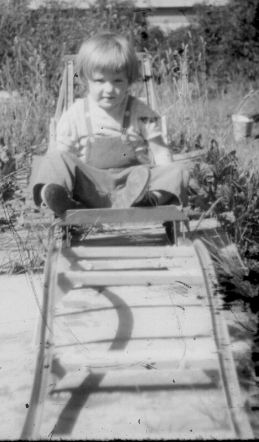
Cindy Beck, Age 5 ½ (Pictured)

Circa Early 1960’s

In today’s world this particular outdoor equipment could never exist but in the 1960’s that was a different story all together.  It was approximately 12 feet long and rose to a staggering 3 feet at its highest point.  There were no seatbelts and no safety systems to protect the riders but it was the most exciting 1.2 seconds a kid could have or adults for that matter.

As roller coasters go this was no “twister” but it was fun and it attracted all kinds of attention.  The rider sat on a flat “sled” with very small wheels and nothing to hold on to.  The ride started at the top, three feet off the ground and dropped slightly before rising up and over the first
hump.  Down a bit further to the second and last hump before screeching to a stop a mere twelve feet from the start.  If you were not paying attention you would arrive at the end, cart stopping in its tracks while the rider proceeded on until gravity did what it required and friction finished the job.

Kids would wait in line for their turn, bickering on whose turn it really was, for what seemed like hours.  The “coasting” was usually only interrupted buy an occasional accident with blood involved or by the proverbial, “bedtime.”  On some evenings when my parents had guests
over for dinner or drinks, the kids would soon find themselves relegated to other activities as the adults took on the “Coaster of Doom.”

I am not sure who actually got the roller coaster but I think it was actually a birthday gift for my brother.  But all of the kids and their friends had hours of fun.  Sure there were scrapes and bruises but none of us ever had to go to the hospital due to a derailment or other catastrophes.  One thing I am sure of is the fact that in today’s world a toy like this would come with all kinds of warnings and lawyer on retainer.

Deaf Camp Picnics – Mercedes 300SEL Off-Road Sedan

1960’s and 1970’s

The 1975 Deaf Camp Picnic was held in the parking area and adjoining field at the bottom of the “Camp Ground” chair lift in the Snowmass Valley.  The picnic had become so successful and attracted so many people this was the only location big enough to hold it.

By this time John Denver had not only committed his own band to perform but also convinced the members of The Nitty Gritty Dirt Band, Jimmy Buffett and The Eagles to donate some of their talents to the music acts.  The bands played for hours and did so rain or shine.  The valley also made the music echo throughout and it gave the music a special sound all of its own.

All of the picnics had no shortage of beer at a very low-cost.  Add to the fact that some of the attendees also enjoyed a bit of “whackie tobackie” throughout the day gave the picnics a very festive feel.  The downside was the fact that the location was 14 miles from Aspen over a dirt road to Snowmass Village or back up valley to the “divide” and over to highway 82.  There was no shortcut to getting home for any of the attendees, although some brought camping gear and slept off their “fun” returning safely home the next day.

At the 1975 picnic I was nine months away from getting my driver’s license and none of my fellow siblings were ready to leave when I wanted to.  Complaining a bit loudly, Steve Weisberg, John Denver’s lead guitarist offered me a ride home and I jumped at the chance.  Steve had been playing in John’s band for a few years.  At the time Steve was married to the daughter of the man who invented Fritos.  The two of them lived up by the Aspen High School in a nearby Highland’s sub-division.

I had met Steve on a number of occasions as John and sometimes his band played in my School every year from when I was in second or third grade until my junior year.  He did it as a favor of my Mom, Pam Beck as well as for another “serial volunteer” in the valley by the name of Trudy Barr.

Steve said his goodbyes to some of the nearby fans and we headed off to his car.  A Mercedes 300SEL with a 4.5 liter engine, it was beautiful!  I was, and remain to this day; a huge fan of Mercedes automobiles and this was by far the nicest one I had ever seen or had the pleasure to ride in.  As we exited the parking lot he had two choices, go left and take the rough dirt road, Divide Way; over the ridge and into Snowmass Village or go right and take the paved roads back to town over the “Watson Divide” and up highway 82.  I was certain Steve would go right as who in their right mind would drive this car on a jeep road?  Wrong! We went left.

I am not saying Steve did not appreciate the finer automobiles of the day but it is safe to say he did not worry about what happened to this one.  He drove fast and flew over the bumps and ruts in the road.  This car had nice suspension but even it could not compensate for the bigger rocks.  He slowed down only once and that was to say “Hi” to a friend headed the other direction, in a Jeep!

We hit the pavement still in once piece and the ride back to town from there was as smooth as glass.  Now I doubt Steve could even recall this particular event but for me, I had a blast and that car was nice!  It only took me 36 years to get one of my own, but it will never go off road.

Thanks for the lift Steve!

“The Deaf Camp benefit, every year, was the most stunning playing experience of my career. It eclipsed Red Rocks, Madison Square Garden and the likes. When the kids would put their hands on the stage to ‘hear’ our music, it was the most memorable audience reaction I’ve experienced to date.” – Steve Weisberg

The Carbondale to Aspen Express

Circa Early 1960’s or Maybe Late 50’s

The “old man” had long been homeless and enjoyed an occasional alcoholic beverage, or maybe more than one.  It is not to say he was an alcoholic, in fact little was known about the man even though he had lived in the valley for years.

What was known was that his past included time working for the railroad so the process of operating a diesel locomotive was not foreign to him.  The time it takes to get a locomotive ready for the rails from a cold start can often take hours so it was not uncommon to leave a locomotive idling in the rail yard for hours if not days.  On this particular day the yard crew had parked the locomotive on a siding while they headed into Carbondale for a meal.  When they returned from their meal, the locomotive was nowhere in sight.

The “Old Man” headed up valley towards Aspen from the Carbondale yard.  What the workers did know was what direction the locomotive had headed but the speed or intention of the hijacker was unknown.  With no other option, they quickly alerted the authorities.  The Roaring Fork Valley was and is still known to this day as a “rumor mill” or epic proportions and I am sure that the rumors of death and doom headed up valley faster than the “old man” and his ride.

The end of the line was just past the Rio Grande Yard in Aspen.  In earlier years the tracks completely circled town but as the mines shut down and the scrap iron was needed for the war efforts of World War One and Two the tracks were eventually taken up and the end was now by the old trestle along the river down by the Riverside Trailer Park, just below where the Aspen Eagles Club is located.  The Riverside Trailer Park was owned by Buck Buchannan who also happened to be the County’s surveyor at the time.

As some of the local authorities started looking for the missing locomotive others started blocking off intersections and evacuating the trailer park.  Convinced that the locomotive was headed straight for Aspen, they focused all of their efforts up valley.

Meanwhile back “down valley” the old man brought the locomotive slowly to a stop near the Woody Creek Store.  Without anyone noticing he”
tied down” or secured the locomotive walked a short distance to a nearby road and caught a ride the rest of the way into town.

It took some time for the authorities to work their way down the valley before locating the idling locomotive in Woody Creek.  The Hijacker
was long gone and probably finishing his second or third beer by then.  As days, perhaps weeks passed, some of the locals figured out who had committed the hijacking but no one was talking, especially the “old man.”


Pirouettes In The Snowmass

Winter of 1978

The original paved road to Snowmass from Highway 82 was a narrow two lane road.  Along most of the route up to the golf course there were fairly substantial ditches or drop-offs on both sides.  As you came out of the valley heading to the village the road curved and followed the side of the valley with the golf course to the south and the Snowmass Stables to the north.  Along this part of the road there were twelve foot ditches on both sides.

When the road was dry navigation up or down the valley was a simple affair but things changed dramatically in the winter especially after a snow storm.  The county did a great job of maintaining the road year round but even the best of plowing, scraping and a light dusting of
sand did little to reduce the slippery effects of the snow and ice.

A good friend of mine, John Braselton, and I spent the evening in town hanging with some other friends and by the time we realized it, the RFTA busses had stopped running to Snowmass for the evening.  With no alternative available, I agreed to give John a ride home despite the slick roads and freezing temperatures.  At the time I owned a 1957 Jeep CJ-3 with marginal tires and a very poor heating system.  Winter travel in this Jeep was always an adventure.

The trip up the valley was uneventful until we passed the Snowmass Stables.  Without warning, and no, it was not my fault; the Jeep began to spin 360s down the narrow road.  Luckily, no one was coming the other way.  After about three full rotations (pirouettes) the Jeep left the roadway and proceeded into the ditch.  Both of us were holding on for dear life and praying out load that the jeep would stay on its tires and not roll over.

We came to a stop at the bottom of the ditch in about two feet of snow which had plenty of mud buried underneath.  We both looked at each other with looks of amazement and a bit of lingering fear.  “What now” proclaimed John?  With any luck we could drive out of our predicament with the Stable’s road a few yards ahead of us.  It would give us a fighting chance.

That particular Jeep required a little extra effort to put it in four-wheel drive.  Now days you just shift the transmission into low but on the vehicles back then you had to climb out and lock the front wheels into four-wheel drive.  Each wheel had a knob on the hub that you had to turn to accomplish the task.  Unfortunately, it usually required the Jeep to move a few inches before locking the first wheel and additional moves before getting them both locked.  In this particular instance the Jeep would not budge and the rear wheel just spun in the mud.  After a few tries I was successful at getting them locked.  Without hesitation the Jeep began to move and in a matter of minutes we were back on the roadway.

The remaining journey up to John’s house was done in silence.  The trip home took twice as long as I approached every inch of the road as if it
were a sheet of ice coated in oil.  As I passed by the part where we performed our pirouettes I could clearly see the tracks in the road where we performed three complete, and perfect I might add, rotations and where we left the road.  Had it happened 10 feet sooner we would have been in a whole about 20 feet deep with a significantly different outcome.

The next day after our nerves had calmed back down we began to tell others of our misadventure and “near death” experience.

The Runaway Jeep Commando

Summer 1973

In the 1970’s my father had a Jeep Commando, or depending on its actual year it might have been a Jeepster Commando made by Kaiser Motors.  Either way it was a workhorse.  In the winter it was fitted with a plow and a hydraulic system and was used for every storm to
plow local driveways and back alleys.  I personally drove it into more snow banks and deep ditches than I could count.  Opal Marolt had that Commando to thank for winter passage out of her long driveway out at what is now called the “Holden-Marolt” property.

During the summer it was relegated to errands and an occasional “jeep” trip into the hills around town.  My father was always very generous
with his vehicles and let any of the family members use them as long as they put gas in them when they were finished, a challenge for some of his kids.

In the summer of 1973, long before I was licensed to drive, my sister Cindy took a number of her friends for a jeep trip up Aspen Mountain in the Commando.  This trip happened to be the day before the annual Deaf Camp Picnic and my parents were busy with the final preparations of
the picnic.

The trip up was uneventful and the four of them enjoyed a nice day in the “high country.”  On the way down things took a turn for the
worst.  Heading down the road just under Lift One the Commando began to sputter and the engine dies.  Now this particular Commando had an automatic transmission and power “everything.”

Cindy immediately panicked when she went to stop the vehicle and nothing happened.  It became sluggish to steer and Cindy stared death straight in the eye.  With no alternative she jumped out of the slow moving vehicle, leaving her companions to fend for themselves.  As she exited the vehicle she fell hard against the road and adjoining hillside and was pretty scrapped up.  The gentleman sitting next to her responded by reaching over and steering the Commando into the hillside bringing it safely to a stop.

Cindy rejoined the group, a bit scrapped up, and was able to get the Commando started again for the return trip home.  Although it was very low on gas it did have enough to get them home but just barely.  Driving the rough road partially starved the vehicle of gas just long enough to kill the engine.  Without the assistance of the engine the powered brakes and steering depending more on human strength and Cindy was unaware of that fact.

As to how she explained her way out of abandoning her friends on a steep jeep road, that part of the story I will never know.

Toklat Aspen – A Swinging Affair

Circa 1960’s

The Toklat Restaurant, long known for its location up at Ashcroft, south-east of Aspen up the Castle Creek Valley actually was once located in what later became the home of the first Chart House Restaurant.

Stewart Mace, proprietor and local naturalist was also a man of vision and creativity.  The Toklat Restaurant was no exception.  One very innovative, if not somewhat misguided, idea was to suspend the tables on bars from the ceiling.  The concept was quit ingénues on the surface.  If you had a table of four and a group of six patrons came in why not swap out the smaller table for a bigger one?

The tables were attached on all four corners and could easily be swapped out for a larger table top by simply detaching it and replacing it with a bigger one.  Aside from the obvious questions of it swinging wildly at the hands of a youthful guest it made for cutting your steak or chicken a family affair.  The upside was that there were no legs to jam your knees into and playing “footsie” with others at the table was an unobstructed game.  My sisters loved to kick me in the knee whenever I said something they did not agree with and they were deadly accurate without table legs getting in the way.

One evening while at dinner with my family tragedy struck.  I am not sure it was the first time an event of this type took place but it was most
likely the last.  That night and elderly man came in with his family.  Assisted by the use of a cane the gentlemen approached the table and reached out to it to improve his balance.  Without warning, as his hand pressed against the corner of the table it promptly swung out of the
way and the man fell to the ground.  To add insult to injury the table clocked him in the head on its back-swing and down for the count he went.  Faster than a bolt of lightning he was quickly surrounded by family and employees alike.  He was actually good natured about the whole event, if not a bit embarrassed.

Our next dinner at the Toklat was a few months later and one notable difference was the chains attached to each table and tied to the floors.  Gone were the free swinging tables we all knew.  A few years later the Toklat moved to Ashcroft and The Chart House moved in from the old A-Frames over by The Little Nell where it originally started.  The Chart House Remained in that location until the mid-2000’s when it finally closed its doors.