Is that a Coal Shed or a Meat Locker?

1880’s to 1974

Our property included the main house and two “out buildings.”  Over the years the larger of the two out buildings, a garage/carriage house,  was removed, leaving the Coal Shed and Wash Room still standing.  Elizabeth Beck, my great grandmother, did her laundry in the front half of the shed with coal for cooking and heating stored in the back half.

As a small child growing up on the property, I paid the old shed little attention.   It was used as a place to store parts and equipment for my father’s earth moving business, “Dooger Digging Excavating” as well as the usual family items that get stored for decades.  The kids in the family used it as a “playhouse” when there was enough room to do so until years later when Marvin Moriarty gave us a playhouse of our own.

I remember on one occasion walking into the back half of the shed and much to my surprise there hung five or six deer from the overhead beams.  It had been a successful hunting season for my father and his friends, and they were using the shed as a place to prepare the deer for eating or freezing.  I did not realize they were in there and it caught me off-guard.  The urge to play in there was gone in an instant.

This was not a watershed event; there was nothing evil or lascivious about those animals hanging in the old shed.  It is just one of those memories, no matter how brief, that has stayed on my mind as if it happened just days ago.  I asked my father recently if he used the shed for that purpose often and he does not recall doing more than once or twice.

In 1974, when our house was being moved to “The West End” the old shed was left behind.  My parents did move the “free standing” garage along with the house but the new property did not have the room for the shed.  Sepp Brungs, the owner of the “original” Molly Gibson Lodge, next door had purchased the property.  As a part of the property sale, the shed was to be torn down by my father. 

After standing for nearly 90 years, time had come to an end for the old shed.  It had served the family well, providing a dry place to store wood and coal, a Landry room for generations and a great storage area.  Old pictures of the house include the shed, or sheds over the years.

“Trader Ed’s” Self Serve Saloon

Trader Ed’s was a unique saloon located on Hyman Avenue in the building next to the “Blue Drug.”  Over the years this location was home to many restaurants and bars, among them were Tico’s and Toro’s.  The lower level had a history of its own as Alice’s Alley, The Woodlander and eventually “The Slope.”

Trader Ed’s was owned by Ed Brennan, a long time Aspenite who was known for such endeavors as a Flower Guide, Hotelier and an accomplished saloon owner.  I had the pleasure of going to school with Ed’s daughter, Mary, although we were never close friends.

During the years of Trader Ed’s many great things happened in the old establishment, some of which are still talked about at every “old timers” gatherings.  As this story goes, my father, Neil Beck ran into Earl Hose’ and they decided to go have a couple of beers.  They chose to go hang out at Trader Ed’s.  When they arrived they found the bar dark but the door was unlocked.  They headed in and made themselves at home.

Much to their surprise, as they were filing their beers they found a “stack of cash” sitting on the bar.  As the guests had before them, they paid for their drinks and sat down to enjoy them.  Not long after that, they heard someone fumbling for his keys as Ed walked in.

“Hmmm, I must have forgot to lock up” Ed announced with a bit of surprise to see Neil and Paul sitting there.  As he approached the bar he commented, “Looks like business was good,” as he picked up the pile of cash sitting there.

Many stories of Ed and his antics still exist today, all of them in good fun or complimentary to him and his legacy.  Ed had experienced many trials and tribulations over the years; but, he is remembered fondly by the people who got to know him and called him “friend.”

I “Otto” Go Fishing

Circa 1974

The Hotel Jerome spent a number of years as an office building awaiting an investor willing to invest enough to bring her back to her old glory.  In the early 1970’s while still in the service of providing office space for local businesses, the Hotel Jerome’s second floor overlooking Main Street was home to Thomas Wells Associates (Architects).  In the summer of 1974 I was offered a chance to work for Thomas Wells and his associates as an office assistant and “architect in training.”  Tom was a very successful local architect and his staff included the likes of Gerry McCarthy and a young, up-and-coming architect by the name of Greg Otto.

Greg was one of those people every young man wanted to be like. He was boyishly handsome, had a beautiful wife and always knew exactly what to say for every conversation.  He was an avid outdoorsman with a passion for fly fishing.  He was still in the service of our country as a member of the Colorado National Guard when I first got to know him.  Once a month he would report for duty and was assigned to a post near Boulder, Colorado.  As an architect he was still honing his skills under the direction of Messer’s Wells and McCarthy.

His childhood dream was to someday own a Porsche 911, and in 1974 he realized that dream.  He was very proud of his new car and loved to give me rides home after work to share in the fun.  

During the summer months Greg invited me to join him on numerous outings to the various rivers in the valley despite our 10 year age difference.  He loved to teach me the art of fly fishing.  He also got me interested in tying my own flies and selling the extras to “Chuck Fothergill’s Outdoor Sportsman” store which was located in an old building that was once a local bowling alley.  It was eventually replaced by the building that is now Boogie’s Diner.  Years later, Katie Stratford continued to teach me fly tying techniques and I became pretty good at it.  Chuck as well as Jim Ward were hard to impress; but, as I got better they ended up selling more of my flies.

Nearing the end of that summer Greg headed off to his “weekend warrior” duties.  Prior to Greg’s departure, he gave me the gift of my own rod and reel.  I was a dinner guest at his house that night and little did I know it would be the last time I would ever see him.   Two days later, I was awaken early that morning by my mother with very sad news.  Greg had been killed in a car accident near Boulder.  As the story goes, he broadsided a vehicle when it failed to stop at a stop sign on a backcountry road.  Greg and the passenger in the other car were killed instantly.  The driver of the other vehicle walked away from the accident with barely more than a scratch.

Greg’s wife remained in the valley for many years following Greg’s death.  She eventually remarried to one of Greg’s best friends and the last I heard they were living in Carbondale.  Greg would have been pleased to see her so happy.

35 years later I still think of Greg often, especially whenever I go over the Castle Creek Bridge, it was one of his favorite places to stop and watch the river below.

Aspen, The Land Before Paepcke

Aspen has a very colorful history that dates back to the Ute Indians, the mining boom and eventual bust and ultimately to becoming a world class ski resort.  Most people speak of Aspen’s history with a vague reference to anything that took place before the arrival of Walter and Elizabeth “Pussy” Paepcke.  Elizabeth is often quoted that “when she came to town there was only one light over Main Street swinging in the breeze.” 

Don’t get me wrong, Aspen benefitted from the arrival and generosity of the Paepcke family.  They brought the community the Music Festival, Aspen Airways, The Aspen Airport, The Meadows, The Institute for Humanistic Studies, they provided the needed money to get the Aspen Skiing Corporation up and running and they invited their world class friends to come to town and spend their money.  Aspen would not be the same today without them, but wait!  There is more to Aspen’s story and it goes back 60 years prior to the 1945 arrival of Aspen’s greatest benefactors.

There is no denying the fact that between the 1893 “Silver Crash” and the end of the Second World War, Aspen struggled.  What is often over-looked is the fact that someone kept the town alive during those tough years so it would still exist upon the arrival of the Paepckes.  Without those hard working families, many of which still live in the valley, Aspen would be no different than many other small mining communities of Colorado such as Lake City, Creed, Silverton or Tincup.  All great towns, but they survive to this day as historic locations that only have a past to talk about.

Aspen owes its existence to the Willoughby brothers who mined past the glory days.  How about the ranching families like the Chisholms, the Vagneurs, the Gerbaz, the Smiths or the Andersons?  They provided livestock and other foods essential to the residents.  Let’s not forget the Browns (DRC’s family), the Moore’s, the Herrons, Koch’s, Tomkins, Shaws, Dolinseks, Deanes, Cowenhovens and “yes,” the Beck family.

All of these families worked hard for the community and they stuck together to keep Aspen alive.  Not for profit but for family.  Aspen has so many people to thank and among them Walter and Elizabeth.  I am just proud to be a part of one of the families that gave the Paepckes something to work with.

I know I have left out a lot of names of families who gave the Paepckes a place to call home, and for that I mean “no offense.”  Aspen is a wonderful place, and let’s not forget those who got her through the tough times.

Growing up on Hopkins Street

1956 – 1983

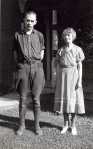
Long before I came into the picture the house on Hopkins belonged to my great grandmother, Elizabeth Rockefeller Beck.  Yes, she was somehow related to that other RockefelleHenry & Elizabeth (1930's)r family back east but I am not sure of the connection.  Elizabeth was married to John A. Beck and together they lived in the house up to and beyond John’s passing.  The house was originally built by them in the early 1880’s.  As she was getting on in years she asked my father to live next door so he could help care for her.  At the time my parents were living in a trailer house up by the original Lift One.  The move would be a simple process and set the stage for more moves of its kind in the years to come.

House Moving - July 1956With the trailer located on the lot next door my father built a nice entryway, a boardwalk from the street and it was “Home Sweet Home.”  This move took place in 1956 not long after my oldest sister, Cindy, was born and less than a year from the birth of my older brother.  The family dog was a German Sheppard by the name of Archie. He, too, was the start of a very long run of Sheppards we would have as pets over the years.
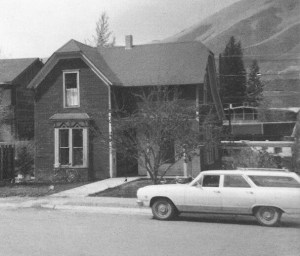
The original house had an “outhouse” as well as a second building on the lot that served as a wash room and coal shed.  Inside plumbing to include a laundry room and bathroom was still a few years off.  Wood and coal burning stoves kept the house warm in the winters and the one in the kitchen served as a stove for cooking year round.  The house provided all of the necessities of life and was comfortable to say the least.  The front entry had two doors at the time, one for entry into the living room and a separate door directly to the left for access to the formal dining room where most of the family gatherings took place.

A few years later, my father purchased the home from his dad after Elizabeth’s passing.  By then his familyThe House on Hopkins Street had grown to three kids with another one, me, on the way.  He added an addition onto the back that provided a full bathroom and mudroom.  With three bedrooms upstairs there was plenty of room for his growing family.
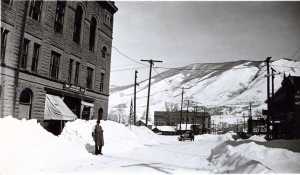
Eventually, the trailer next door was removed and the lot was sold off.  A house was built on the far side of the lot that was home to the McTarnahans and later a temporary home for Peter and Barbara Guy while their house was under construction.  The Molly Gibson Lodge was eventually built on the property next door, sometime around 1968.

I came into the picture in 1960 and lived in the house until my graduation from college in 1983; although, it was not always on Hopkins Street. (See related story)

Are You New to the Valley? Beck Family History

Ever since I started writing my adventures, people are always asking me things like:  How are you related to Paul?  Is Neil your dad?  Are you the same Becks as the Distillery Henry A. Beck from the “olden days?”  Was Pam your sister? (I especially like that one.)  You can’t be Cindy’s brother, you have red hair.  And the best one, “Are you new to the valley?”

In order to make a point and perhaps give my stories a little credibility, I want to give a brief history of my family.  I have to admit that I have not spent enough time researching the topic to include everyone from the day we arrived in the valley; but, I will do my best and ask for forgiveness from my family for any errors or omissions.  So here goes… 

I have always said I am the 5th generation of Becks to live in the valley, and this will certainly prove that point.  So, how come I cannot get Pioneer plates?  Well, I guess that question is best asked in another forum.

John A in front of 'John A Beck Grocery' in 1936John A. Beck came to Aspen sometime around 1882, give or take a year.  He was from New Diggins, Illinois.  The big city back then was Galena (kind of like Raleigh if you lived in Mayberry).  John decided to take John B.L. Soule’s advice and “Go West young man…”  I know, by now you are thinking I have my history all wrong, that was Horace Greeley who said that.  Well, check your history books.
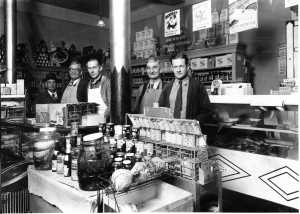
John and his young wife, Elizabeth Rockefeller Beck came to town and set up shop as local grocers.  Not long after that John A.’s dad and Uncle “Willie” followed him to town.  Stick with me now, we are already up to two generations in the valley; three more to go until you get to me and my generation.

Beck Brothers Grocery - (Scan from Slide) 1936“John A” not only set out to establish a life in the Aspen Valley but his desire to have a family was also in his plans.  He and Elizabeth had Alton C. Beck as their first born, and not long after that Henry A. Beck was brought into the world.  Generation three was now in the valley.  By the end of Alton and Henry’s teen years “John A. Beck Fancy & Staple Groceries” was to be transferred to the boys and soon became “Beck Brother’s Groceries.”  The store was located in the Wheeler Opera House building for most of the years it was in business.
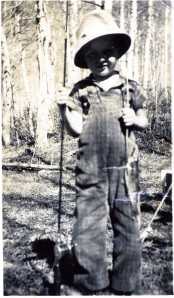
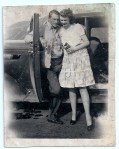
Alton and Alma Beck had three children; Glenn, Paul and Sandra.  At the same time Henry and Pansy had two kids; Shirley and Neil.  OK, if you lost count that was the origin of the fourth generation.  And if you were paying really close attention, that was the second generation to be born in the valley.Neil's first Fish - Circa 1940

Both Paul and Neil spent their childhoods growing up around the family business in the grocery.  They even took their turns delivering groceries twice a day by horse team around town.  For some of Aspen’s residents this was the only company they got each day.   They also worked as stock boys, baggers and even butchers.  During the quiet years of the depression most of the groceries were purchased on credit and paid for after the economy turned around.

Glenn Beck moved away to pursue his career eventually having three kids of his own.  Paul had two kids and I am not sure if Sandra ever had any children.  Paul’s kids remain in the valley to this day as do Glenn’s two daughters.  At the same time my dad married Pamela Worden and they had four kids of their own.   I am the youngest of the four preceded by Cindy, David and Debbie.  Now for those of you keeping track, that is five generations of Becks of which three generations were born in the valley. 

My sisters still live in the valley although not within the city limits of Aspen.  I have hopes of returning to the valley to raise my kids within the next few years.  My sister Debbie gave birth to her three kids in Aspen; so, we are really up to six generations, four born in the valley.scan0041

For a little more clarity:

  • Shirley Beck married Nelson “Jr.” Smith and they had 3 kids.
  • Debbie Beck married Michael Kendrick and they have 3 kids.

 And now to answer the questions:

  • How are you related to Paul?  He is my first cousin once removed.
  • Is Neil your Dad? Yes
  • Are you the same Becks as the Distillery Henry A. Beck from the olden days?  Nope, that was Hilder Anderson’s father.
  • Was Pam your sister? No, my mother
  • You can’t be Cindy’s brother, you have red hair.  OK
  • Are you new to the valley? If you compare my family to the Ute Indians, yes.

The Skies Are Busy Tonight

December 1968

“Continental 427, You are cleared to land”

“Continental 427”

“I sure hope they did not lose my bags this time”

“Yeah me too”

“United 56 Heavy, descend and maintain one, two thousand”

“United 56”

“Ladies and Gentleman, On Behalf of Braniff let me be the first to welcome you to Denver, Colorado”

“Lear 25 November Bravo, taxi to the Combs Gates ramp”

“November Bravo”

“Do you see that Convair at four O’clock?”

“Sure would not want to land there”

“Winds calm, Aspen you are cleared to land”

The conversations between the tower and the aircraft were as easy to understand as the passengers talking to one another.  Keeping it all straight was a mystery to everyone in the camper that night, except for me as I was the one saying it all.

Some people just “ramble” when they talk in their sleep but not me, at least not when I was young.  Every year around Christmas my family would load up the car or camper and go to Denver for a Christmas shopping extravaganza.  Sometimes we would stay at the old Hotel Denver on Speer Boulevard and other times we would stay in an RV park out on West Colfax.  In 1968 we took our pick-up camper and stayed on the west end.

As my mom used to like to tell the story, that night in the camper I started talking in my sleep and proceeded to “control the skies over Denver.”  Not only was I the control tower but I was also the pilots and the passengers.  Over the span of my rant I successfully landed a number of aircraft, lost no baggage, kept an eye out for other aircraft in the pattern and prevented a few “near misses.”

In looking back on my life, I spent considerable time listening to the aircraft scanner as a child.  From our house I could pick up the Aspen Airport Tower as well as Denver Center which controlled the airspace over Colorado and parts of Utah.   I even picked up the airline’s private frequencies and listened to the pilot’s conversations.  I guess if you listen long enough you begin to pick up the “lingo.”

Sleep tight, the skies are safe tonight!

Poof! You’re a Cab

Aspen Airport – Summer 1974

The Learjet caught my attention as it touched down across from me on runway 15.  Even in the 1970’s Aspen received a number of private jet landings every day.  On this day we witnessed one of the first Learjet 35A’s ever made.  This model of Learjet had been in production less than a year and only a few customers had them.

In 1974 I was spending my summers and some of the school holidays working for Monarch Aviation.  Monarch was the Fixed Base Operator (FBO) for the Aspen Airport at the time.  It was owned by the Pabst Family and was based out of Walker Field in Grand Junction.  The job was fun as I was allowed to drive vehicles on the airport ramps even though I was too young to legally drive.  I towed aircraft around with the tugs, fueled them, heated up their engines and even got to use the external Auxiliary Power Units (APUs) to help the turbine engines get started on occasion.  Ramp work was dangerous but it also provided an opportunity to be around aircraft of all types and it was worth the risk.

As the new Learjet 35A taxied towards me I held out the bright orange batons indicating where the nose of the jet needed to be.  As the jet pulled up in front of me I instructed the pilots to make a hard right turn and come to a stop.  Parked and with the engines shut down, the fuel truck pulled up in front of the plane.  Due to the fact that most Learjet’s have wing tip tanks; they must be fueled up on both sides at the same time.  If only one side gets fuel or gets more fuel, the aircraft could easily tip onto its wing causing extensive damage.  The Learjet 35A is equipped with these tip tanks.  My next job was to take one of the fuel lines and fill the left side of the jet.  Coordination is key and as the other ramp worker and I started the fueling process we paid close attention to how much fuel was being put in the jet.

While standing there fueling the Learjet, a gentleman that could not be a day over 35 exited the aircraft.  He looked at me and said, “Hey boy, call me a cab.”  Without thinking I replied, “Alright, Poof! You’re a cab.”  I went about finishing up the fueling process and then alerted another ramp worker of the jet owner’s request for transportation.  Not giving it another thought I went on with the tasks of ramp operations.  About 20 minutes later I was called into the FBO ramp manager’s office. I do not remember his name but he was one of the nicest people around and had a great sense of humor. At the time, Eddie Dropla was the General Manager, but I am not sure he ever caught wind of my comment or how the customer responded to it.  Anyone who knows me well, knows I have a very healthy sense of paranoia and being called to the office made me panic.

As it turns out the owner of the Learjet did not find my comment very amusing, and he asked that I be “fired immediately!”  The FBO remp manager was in no mood to be told what to do by anyone, especially a condescending individual who treated everyone like he owned them.  Agreeing that my comment was funny but maybe a little inappropriate, he asked that I keep my distance the next time I see the jet owner.  Luckily enough, I do not recall ever seeing him or his jet in Aspen again.

This Gulfstream was Gone!

Summer – 1976

Aspen’s airport sits at 7,815 feet above sea level.  That is a geographical fact.  For aircraft operating out of the airport, the meteorological altitude can change based on the humidity, dew point, barometric pressure and air temperature, this is known as Density Altitude.  Density Altitude can affect how an aircraft performs especially during landings and take-offs.  I give this brief lesson as it affects the rest of the story, please read on…

It is the summer of 1976 and Aspen is experiencing abnormally hot weather.  The airport is busy with the usual Jet traffic as well as the Glider Operations that were in full swing.  It was a busy place to say the least.  While delivering some Hertz customers back to their aircraft I observed a Gulfstream II exiting the runway having just landed.  I recognized this aircraft as belonging to Greyhound Corporation.  As it turned out my next pickup was John Teets, the CEO of the company.  I gave him the keys to the car and asked if I could have a look at his Gulfstream.  As he drove away he told the captain to give me a “full tour” of the jet.

As I headed up the stairs into the Gulfstream, the Captain met me at the top and told me I had to leave.  He had never flown out of Aspen in the summer and as he said, “The altitude was rising by the second.”  Complying with his boss’s orders, he started to give a tour; but, I could tell he was nervous and I politely excused myself much to his relief.

Barely reaching the bottom step, the jet’s engines began to spool up.  In less than five minutes the Gulfstream II was taxiing to the runway.  It was about 11:00 in the morning and the temperature was already 75 plus degrees.  The density altitude at that point was probably approaching 10,000 feet but this was a Gulfstream! 

The speakers out on the ramp where you could hear the tower and aircraft communicating suddenly crackled with the panicked voice of the Gulfstream Captain.  Requesting an expedited departure, the Captain indicated that they would do their “engine run-up” at the end of the runway.  He was going to waste no time getting out of here.

The Gulfstream sat on its brakes while the engines came up to full power.  You could hear this Gulfstream anywhere in the valley as its brakes struggled to hold it in place.  Suddenly, the jet lurched forward as it began its take-off roll.  By now the engines were exceeding the 100% power setting as the pilots rushed to get enough speed to take-off before running out of runway.   At the time, the runway was just over 5,200 feet in length with a slight downhill angle for departing aircraft on runway 33.

With the amount of power the Gulfstream was producing, the nose lifted off the runway in just over 1,200 feet and was airborne in less than 2,800 feet.  This Gulfstream was gone!

About a week later the jet and crew were back to pick up Mr. Teets.  This time they were much more relaxed and I was given a great tour of the jet.

Merry Christmas Lyle!

Christmas Day – 1976

My childhood was filled with spectacular events and wonderful memories, but as the song goes “Into every life a little rain must fall.”  This is one of those “rainy day” events.  At my age it is hard to carry a grudge, so for the sake of this story we will call the villain “Lyle.”

It was 7:00 on Christmas morning and like many Christmases in resort communities it was rarely a day off.  On this day I was off to teach ski school at Buttermilk.  I had a little time before I had to be there and I was asked if I could deliver a few gifts on my way.  At the time I was driving our International Scout which had a hydraulic snowplow attached to the front.  I loved driving that car!  It was built like a tank, could take anything you threw at it and most importantly I was one of only two kids in my class with a driver’s license.  We all know what that means, dates!

Back to my story.  I made a few deliveries in our neighborhood and the last planned stop was at the Hickory House.  My parents always gave out Enstrom’s Toffee in boxes of all sizes each Christmas and none of them ever went to waste.  After the gift giving and taking a few minutes to visit I was off to work. 

Like most days, the parking in front of the Hickory House was full as was the side and rear lots.  I ended up parking across Main Street with the Scout pointing east.  I jumped in, looked both ways and headed out onto the street which by the way had no visible traffic.  Out of nowhere suddenly there was a Subaru stuck between the fender and the back of the plow.  Where did he come from?  Had I not looked well enough before proceeding?  We both got out and it was at that point I made my first mistake; I apologized for getting in his way.  Yes, I took the blame for the accident and Lyle, the driver of the other Subaru, graciously accepted my apologies.  Lyle went into great detail to explain that I must not have looked very well as he was coming around the curve on Main Street from the west.

A few minutes later a police officer showed up.  After a brief conversation I was issued a careless driving ticket and we were all on our way.  As for my Christmas it was not going to set the record as the “best ever.”

Later that day I received a call at the Buttermilk Ticket Office where my Mom worked.  It was from the Aspen Police who needed to get some additional details regarding my accident.  The officer who wrote my ticket informed me that the ticket was being “thrown out” and I was not at fault for the accident.

Sitting at the big table in the Hickory House was a group of people who witnessed it all.  As soon as I had left but before the police officer could escape the scene they flagged him down.  Led by Harold “Puppy” Smith and a number of other witnesses, they informed the officer that Lyle had not come around on Main Street as he had claimed.  He had actually pulled a u-turn in the middle of the block across two pairs of double yellow lines and collided with me.  With that information the ticket was “thrown out” and a new citation was issued to Lyle.  As far as I was concerned that was the end of the ordeal and my Christmas was looking up after all! 

Not so fast…

Two months later we received a call from our insurance agent.  Lyle had filed a lawsuit against me and my insurance company.  He was seeking all damages be repaired and a small amount of punitive damages as well.  He was also requesting a civil trial by jury.  At the age of 16 I had never been sued before or even stepped foot into a courtroom.  Now, two weeks before my 17th birthday a court date was set and I was petrified.  My insurance company provided an attorney and they got detailed statements from me as well as the witnesses from the Hickory House.

In a pre-trial motion my attorney petitioned the court for a trial before a judge, allowing the judge to render a verdict after hearing all of the evidence.  The motion was accepted and the trial date was set.  We would be going before Judge Tam Scott in two weeks.

On the day of the trial we all assembled in the court room.  In all we had about 15 witnesses, an attorney from the insurance company, the police officer and my family.  Lyle showed up with a large display board and no one else.  He was going to defend himself.  The look on his face was priceless.

As the trial convened Lyle was asked to go first and make his case.  After about five minutes of him explaining in detail, complete with a map of the area, how he had come from the West around the curve only to have me enter the lane without any notice or indication he rested his case.

My attorney made a brief statement contradicting Lyle’s information and then Puppy Smith was called to make a statement.  As soon as Puppy stated that Lyle had actually pulled a U-turn, having just left the Hickory House himself, Judge Scott stopped the proceedings.  He asked Lyle to stand up and it began…

Over a span of five to ten minutes, the Judge explained to Lyle that he had not only broken numerous laws by his actions, he had put a cloud over a Christmas holiday for me, had wasted the time and money of many people including the court and worst of all he had perjured himself.  The verdict was complete.  Lyle got nothing, had to pay some court costs and was required to apologize to me on the record.

Years later I still run into Lyle on occasion.  He still remembers our encounter and no words are ever exchanged.